Project Area C
Solvation and Dispersion Interactions
In research area C, we will investigate such assembly and solvation effects in photoreactions and photocatalysis with the aim of developing a more general picture and rational use of dispersion interactions in photochemical synthesis.
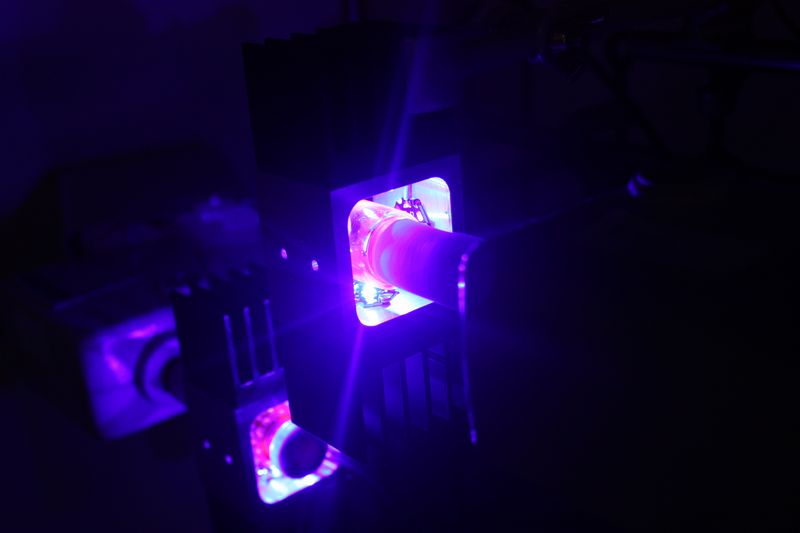
C01: Taming Reactive Intermediates in Photocatalysis by Assembly Control
We investigate the effect of 2D interfaces, such as water-oil or water-oil-gas interfaces, on the reactivity of photoredox catalysis. Photochemical reactions such as cyclizations, cycloadditions, dearomatization, deracemization, and carboxylation will be performed at the water-oil interface. For continuous reaction conditions, we will employ a photo-flow-spray reactor producing water-oil aerosols.
Organic Chemistry, Synthesis
Prof. Dr. Burkhard König
Publications
Key Publications:
Mandal, Tanumoy; Sharma, Rohan; Mendez-Vega, Enrique; Rehbein, Julia; König, Burkhard: “On-water” photosensitization enables redox neutral acylation and alkylation of quinones. Nat. Commu. 2026, 17, 1813
Tian, Ya-Ming; Silva, Wagner; Gschwind, Ruth M.; König, Burkhard: Accelerated photochemical reactions at oil-water interface exploiting melting point depression. Science. 2024, 383, 750-756
C02: Analysis of Charge Transfer Complexes, Radical Ion-Pairs and Photocatalytic Assemblies by NMR Spectroscopy
C03: Photocatalytic Csp2-Functionalizations in Confined Space
C03 studies supramolecular H-bonding networks and their impact on photochemistry to establish them as tools to control and steer reactivity and selectivity in photocatalysis. The first funding period focused on creating supramolecular photocatalytic environments for polyene cyclizations, thereby uncovering an unprecedented mechanism for eosin Y-catalyzed hydrofunctionalizations. In the second funding period we will continue these investigations and expand the reaction scope to unactivated alkene and aryl functionalizations. The project will also explore the properties of photoacids in F-alcohol environments and their suitability in transformations usually requiring strong acids.
Publications
Nicolas, Rascón; Anirudda, Biswas; Tanja, Gulder: Photocatalytic Polyene Cyclization to Cyclopentyl Thioethers with Consecutive Quaternary Centers in Fluorinated Alcohols. Adv. Synth. Catal. 2025, 367, e70030. doi.org/10.1002/adsc.70030
Andreas, Arnold; Philipp, Dullinger; Aniruddha, Biswas; Christian, Jandl; Dominik, Horinek; Gulder, T. Enzyme-like polyene cyclizations catalyzed by dynamic, self-assembled, supramolecular fluoro alcohol-amine clusters. Nat. Commun. 2023, 14, 813. doi. org./10.1038/s41467-023-36157-0.
C05: Development and Application of Novel Quantum-Chemical Excited-State Methods for the Accurate Description of Photocatalytic Processes
We will develop novel quantum-chemical excited-state methods for describing vibronic effects, magnetic properties, and non-adiabatic molecular dynamics simulations based on our constraint-based orbital-optimized excited state method (COOX), make them available to the CRC, and apply them collaboratively within the CRC. In collaboration with experimental groups, new photosensitizers based on ring-contracted flavins and photocatalytic reaction mechanisms in enzymatic environments will be studied. Furthermore, we will support the development of a novel ultra-sensitive NMR technique and a time-resolved EPR method by calculating the relevant spectroscopic parameters.
Theoretical Chemistry, Theory
Prof. Dr. Christian Ochsenfeld
Publications
Current Publications
Lemke, Yannick; Kussmann, Jörg; Ochsenfeld, Christian: Nonorthogonal Configuration Interaction of Constraint-Based Orbital-Optimized Excited States: A Versatile Method for Theoretical Photochemistry", J. Chem. Theory Comput. 21, 2025, 10193–1021
Lemke, Yannick; Kussmann, Jörg; Ochsenfeld, Christian: An embedding scheme for constraint-based orbital-optimized excitations in molecular and bulk environments. Phys. Chem. Chem. Phys. 27, 2025, 12161–12170
Key Publications
Kussmann, Jörg; Lemke, Yannick; Weinbrenner, Anthea; Ochsenfeld, Christian: A Constraint-Based Orbital-Optimized Excited State Method (COOX). J. Chem. Theory Comput. 20, 2024, 8461-8473
Drontschenko, Viktoria; Ochsenfeld, Christian: Low-Scaling, Efficient and Memory Optimized Computation of Nuclear Magnetic Resonance Shieldings within the Random Phase Approximation Using Cholesky-Decomposed Densities and an Attenuated Coulomb Metric. J. Phys. Chem. A. 128, 2024, 7950-7965
Peschel, Martin T.; Kussmann, Jörg; Ochsenfeld, Christian; de Vivie-Riedle, Regina: Simulation of the non-adiabatic dynamics of an enone-Lewis acid complex in an explicit solvent. Phys. Chem. Chem. Phys. 26, 2024, 23256-23263
C06: Design and Directed Evolution of Artificial Photoenzymes
Photoexcitation of natural or synthetic chromophores in the chiral environment of proteins gives access to new photoenzymatic activities. In work package 1, we utilize naturally occurring redox enzymes and enable stereoselective photocatalysis by repurposing pyrroloquinoline quinone (PQQ) and flavin cofactors, respectively. In work package 2, we equip de novo designed protein scaffolds with a synthetic thioxanthone-based photosensitizer to achieve stereoselective photocyclizations. In both cases, we combine computational modeling and directed evolution to optimize catalytic efficiency and stereoselectivity.
Biochemistry, Protein Chemistry
Prof. Dr. Cathleen Zeymer
Publications
Key Publications:
Bahukhandi, Srishti B; Klein, Andreas S; Mustafa Ghulam; Weyh, Maria; Walter, Alexandra; Thyrhaug, Erling; Hauer, Jürgen; Storch, Golo; Zeymer, Cathleen: The Natural Redox Cofactor Pyrroloquinoline Quinone (PQQ) Enables Photocatalytic Radical Cyclizations. Angew. Chem. Int. Ed. 64, 2025, e202505431.
Boesen, Benedikt; Heider, Anna; O’Shea, Jack M; Groll, Michael; Bach, Thorsten; Zeymer, Cathleen: Enantiodivergent Evolution of a De Novo Protein for Enzymatic [2+2] Photocycloaddition Activity. ACS Catal. 2026, DOI: 10.1021/acscatal.5c08946 (accepted manuscript, available online)
https://pubs.acs.org/doi/10.1021/acscatal.5c08946
C07: Machine Learning Insights into Catalyst-Substrate Assemblies for Rational Design
Project C07 aims to enhance our understanding of light-driven chemical reactions within the CRC by applying advanced machine learning methods. On one side, computationally efficient machine learning-driven photodynamics simulations on longer time and length scales will be used to study long-lived excited states of ring-contracted flavins and reactions at interfaces, respectively. In addition, machine learning will be used to guide rational catalyst and substrate design and will be integrated into experimental workflows to optimize reaction conditions and experimental planning.